Two-wheel traveller, occasional worker, and quiet recorder of old moments. Writing vignettes, short pieces, and poetry about past lives, daily routines, and the space between memory and place.
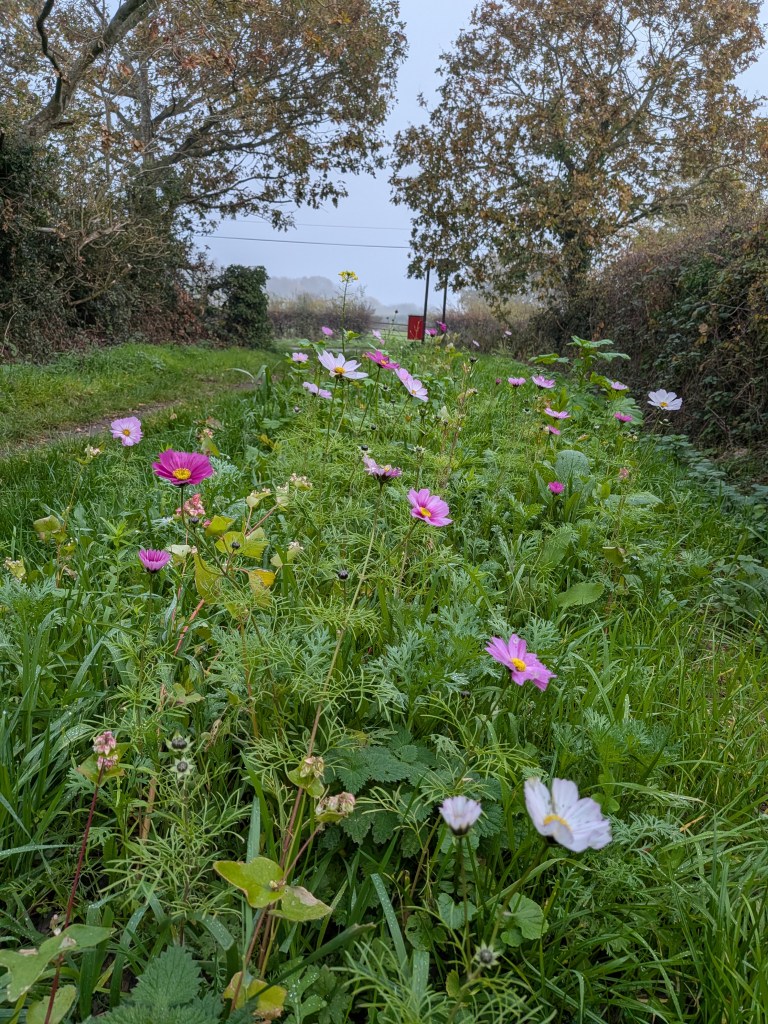
Over the spring, the entrance to the bridlepath had been opened up. Heavy boots, yellow diggers, and metal tools had pulled back the turf to reach whatever pipes and valves slept beneath the soil. When the work was finished, the ground was levelled over and left to its own devices: a rough strip of raw earth against the dark swell of the hedgerow.
Yesterday afternoon was cold, damp, and wrapped in fog. The sort of November day that reduces the landscape to muted greens and browns. I was expecting only the wet rustle of oak leaves underfoot and the smell of rain-soaked grass.
Then a flash of colour stopped me in my tracks.
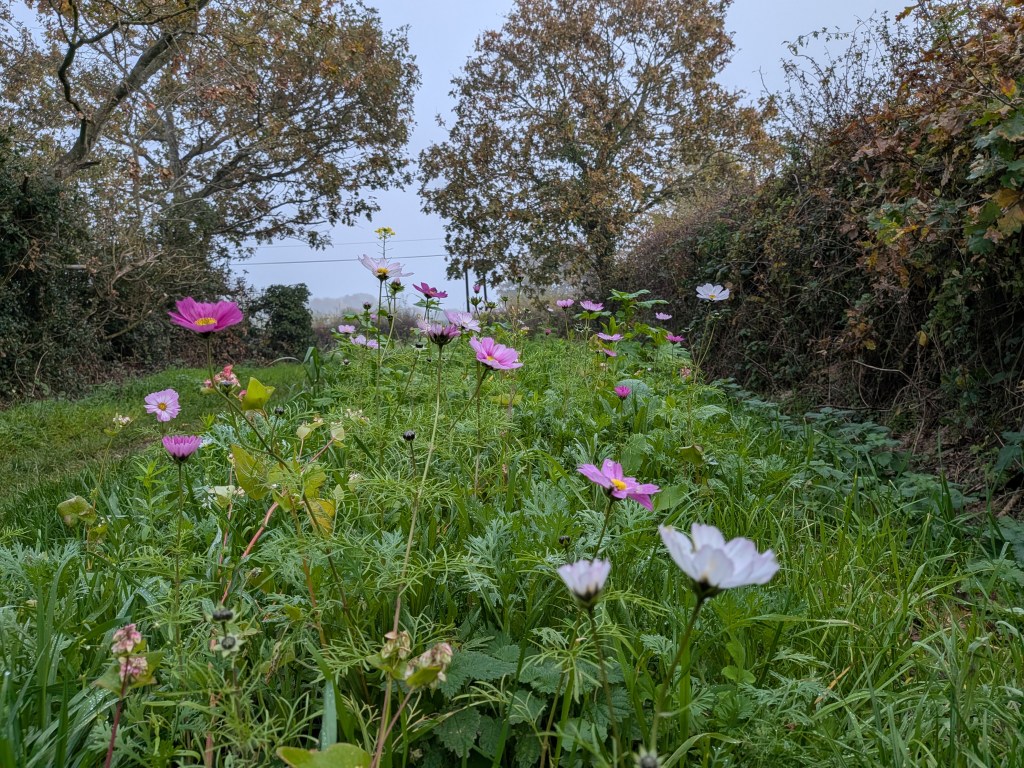
There, standing above the grass as if summer had lost its way, was a scattering of bright pink, magenta, and white blooms. Cosmos, I think. Delicate flowers balanced on slender stems, luminous against the grey haze.
They do not really belong here, at least not in November. Native to Mexico and Central America, cosmos thrive in warmth and sunlight. A single hard frost is usually enough to blacken their stems and send them back into the earth. Yet here they were, blooming cheerfully on the England-Wales border, apparently oblivious to both the calendar and the season.
Nature did not place them here entirely by herself.
At some point after the machinery departed and the contractors packed away their tools, someone must have passed this way carrying a pocketful of seed and a quiet intention. Perhaps they paused for only a minute or two before scattering them across the bare ground. Nothing official. No plaque. No announcement. Just a small act of anonymous optimism.
Months later, the flowers remain.
They will not survive the winter. The first serious frost will finish what November has so far postponed. By spring, nettles, grasses, and whatever else the hedgerow chooses will reclaim the bank. The cosmos will be gone.
But for now, they brighten an otherwise ordinary corner of the path.
As I stood looking at them, I felt a pang of disappointment knowing they would soon be lost to the first real frost. But perhaps that misses the point. The person who scattered these seeds was unlikely to have expected them to last forever. They only needed to flower once. Standing there among the fog and fallen leaves, I found myself thinking about spring. Perhaps next year, with a pocketful of native wildflower seed, I might return the favour.
On a foggy autumn afternoon, they felt less like flowers and more like a message. A reminder that beauty does not always arrive through grand designs or careful plans. Sometimes it appears because somebody saw a patch of bare ground and decided it needed something more.
And months later, a stranger walking past stopped to notice.
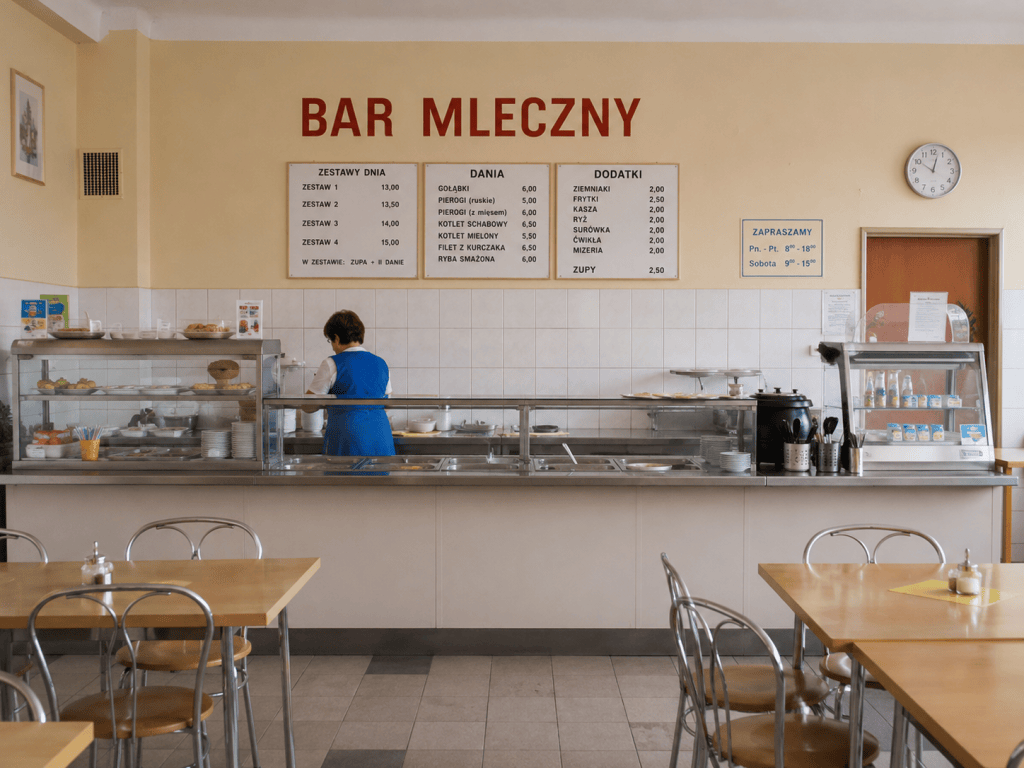
Before moving to Poland, my understanding of a bar mleczny was pieced together from guidebook glossaries and half-remembered UK history. I had a vague notion they might resemble the old Milk Marketing Board cafes from 1960s Britain — sleek milk bars with stainless-steel counters milkshakes, soup and light bites. But a Polish friend explained the real concept to me: state-subsidised canteens offering cheap, hot, traditional meals to anyone who walked through the door.
I was fascinated. What started as a tourist’s curiosity during an early trip in 2009 eventually became a quiet fixture of my life when I eventually moved to work and live in Silesia.
This is the first of three pieces tracing that shift, starting on a soot-blackened street in Bytom.
Zupa… Zupa…
My first milk bar experience wasn’t quite what I expected, though not for the reasons I imagined. Visiting Poland sometime in 2009, I met up with my friend in her home city of Bytom. We were wandering along Dworcowa, the city shifting between soot‑blackened buildings and pockets of unexpected charm, when we passed a milk bar. I asked if we could eat there. My friend laughed softly — sure, we can eat here — a laugh that carried both affection and a hint of warning.
Inside, my expectations were met instantly. The women behind the counter were exactly as I’d been told: strong‑willed, confident, efficient. No nonsense, but not unkind. The room held a thick, unmistakable fog — a signature weave of steam, simmering soups, hot oil, and boiled cabbage. I didn’t realise it then, on that very first visit, but that scent didn’t just hang in the air — it inhabited whatever you wore. In the months and years to come, as milk bars became part of my weekly rhythm, I learned how it seeped deep into any fabric. It didn’t matter if it was a heavy winter coat, a cotton sleeve, or a knitted scarf tucked into your collar. Long after you’d stepped back out onto the street, it remained — a quiet, lingering calling card that gave away exactly where you’d just eaten.
The formidable matriarchs were slightly surprised, but patient as my friend translated the menu, though I felt a little stressed — clearly this was the sort of place where you needed to know exactly what you wanted before you reached the front of the queue. The menu looked as if it had been hanging there since the 1970s, and I chose hastily: fasolka po bretońsku with a bread roll — bułka. I didn’t know it then, but this soup would become my safe harbour in the early days of living in Gliwice, the one thing I felt confident ordering.
The soup was actually a stew — big chunks of meat and white beans, smoky, savoury, velvety — and the bread roll was perfect: crisp, golden‑brown crust, soft and slightly sweet inside. I adored it. My friend ordered pierogi ruskie, a dish beloved by everyone I later met in Poland, though it never quite won me over. I grew to enjoy other types of pierogi, but not this one — much to the shock of friends and students. I recall my friend laughing as I asked if my soup was really a Breton dish. She had no idea. It didn’t matter. This dish was far superior to the baked beans in tomato sauce I knew so well.
As we were eating, the atmosphere shifted. A man approached our table — older, though perhaps only because life had worn him down. He spoke quickly, urgently. I didn’t understand the words, only the tone. My friend did. She leaned in and whispered, “He is asking for money to buy soup.”
I hesitated. She gently declined him, the way locals knew to do, but something in me resisted the idea of turning away. I asked if we could buy him a meal instead. She agreed, seeing what it meant to me. But when she tried to order soup for him, the staff refused — not angrily, but with the weary firmness of people who had already reached their limit. He had already been given soup that morning, she explained. He had been sitting there for hours. They wouldn’t serve him again, and they wouldn’t allow us to buy it for him either.
His distress broke open instantly. He sobbed and pleaded with the women behind the counter, pointing to my friend and me, eventually repeating a single word — zupa… zupa. It wasn’t only hunger; it was hope collapsing right in front of us. The staff gestured for him to leave. My friend tried to explain the situation, but nothing softened the moment.
I felt a deep, helpless sadness.
That was my first milk bar experience. Not the comforting, nostalgic scene I’d imagined, but something far more human — complicated, uncomfortable, unforgettable.
Even now, years later, I can still see his distress, and hear his despair repeating two words.
On tiny lifelines, a smoothie hat, and remembering how the laughter used to sound.
A small work written on the 10th October 2026.
Today is World Mental Health Day 2026. Rather than write about the heavy weight of things, I wanted to share a story about a tiny knitted smoothie hat, an origami book, and a friendship that built a bridge across the dark when I needed it most. I hope it brings a little light to your reader today.
A Short Story about Bunny and Chuchus
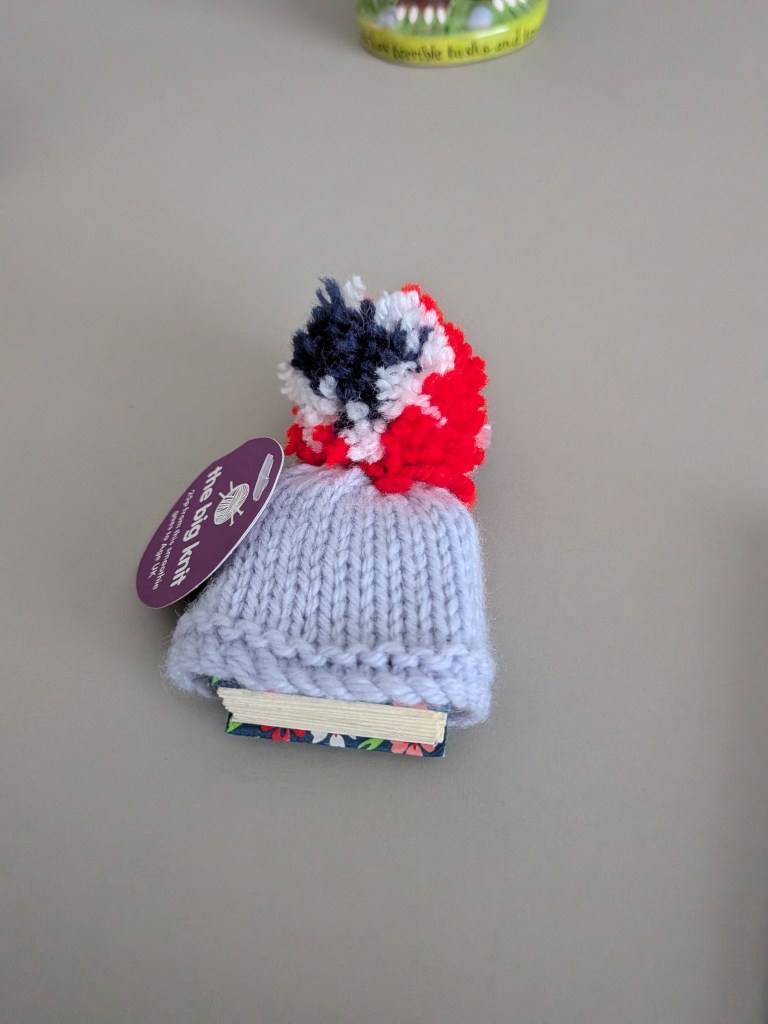
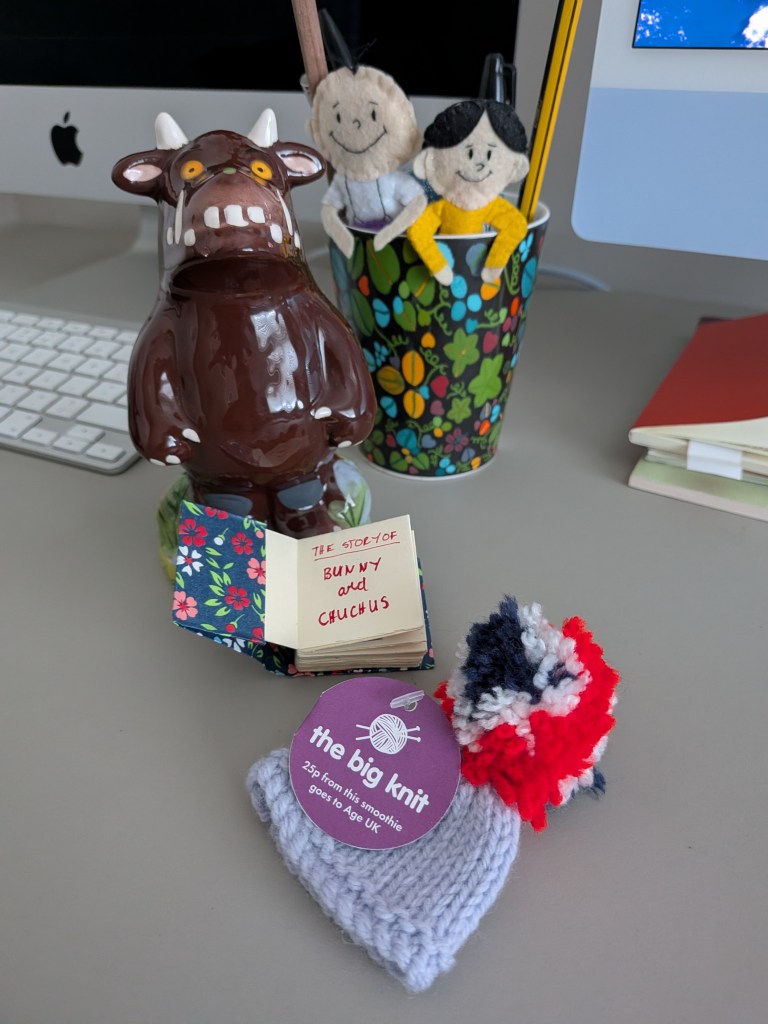
I keep a small handmade book inside a tiny knitted hat.
The book is an origami fold, precise and thumb-sized, bound in a vibrant floral cover of blues and red blossoms. The hat was never made for books; it originally sat on top of a smoothie bottle as part of The Big Knit, a fundraising campaign where volunteers outfitted small bottles of fruit smoothies in woollen beanies to raise twenty-five pence for Age UK. I couldn’t stomach the smoothie, but I continued to buy the smoothie to donate, collect and keep the hats.
Several seem to have vanished over the years; I still have maybe three or four left. Recently, my granddaughter Lottie pointed out that perching a woollen cap on a Gruffalo money box was entirely inappropriate. Gruffalos, she explained with immense patience, do not wear hats. It was difficult to argue with her logic. I agreed that Lottie could keep the hat to do with whatever she pleases.
The beanie book protector is pale grey with a red, white, and blue bobble, its original cardboard label still tucked against the wool.
Inside lives the book.
The title page reads The Story of Bunny and Chuchus, written carefully in red ink.
I hadn’t opened it in years. When I turned the pages today, I found photographic prints so small I still don’t know how they were made — scarcely larger than a fingernail, yet as sharp as the day they were printed.
The first shows a younger version of me in a t-shirt emblazoned with the words Trouble Maker. Thirteen years ago, though I look years older than I actually was: the visible residue of a life quietly collapsing around me while I walked blindly through the wreckage.
On the third page, an arrow points toward the logo of a language school where I taught English in the Silesian city of Bytom.
Everything started here →, the caption reads.
I laughed aloud. For years I had sworn up and down that the story began in Zabrze. The tiny book knew better.
As I turned the pages, more memories appeared. Tiny fragments of a life I had almost forgotten. Not the big moments, but the little ones — the moments that seemed entirely ordinary at the time.
One memory arrived accompanied by an image of a fridge magnet I’d been gifted. It features a cheerful 1930s-looking doctor in a white coat and beneath him the words:
Bier ist gut, sagt der Arzt!
One afternoon, sitting in my kitchen, I remember staring at it and asking Bunny: “Sorry, what’s an Arzt?” “Arse?” she replied. “No, Arzt.”
By this point we were both completely confused. I pointed to the magnet, and she burst out laughing.
“It’s German. Doctor.”
I was genuinely stunned. “Not Doktorrrr?” I always tried to trill that phonetic r. “Nie. Arzt.”
To this day, I can hear her laughing.
I suspect I am one of the few people in the world who finds that exchange memorable, but that is how friendship works. A conversation about a fridge magnet somehow survives for many years while more important things disappear completely.
The tiny book is full of moments like that. A coffee shop logo. My Dutch bicycle outside my favourite kawiarnia. Even the phrase “going out on the lash”, which Bunny found hilarious because she had never heard it before. (We did, in fact, go out on the lash — the logo of a Katowice new wave bar we frequented is right there on the page.)
It’s not the big moments. It’s the little ones. The sort of moments that matter more than you realise until somebody takes the trouble to preserve them.
The micro-book was only a fraction of it. There was a whole custom-built notebook she sent alongside it, populated with prompts, games, and quiet anchors — like eight deliberate suggestions on how to stay curious when the world feels like it’s narrowing to a pinhole. Those weren’t just quirky gifts; they were a lifeline crafted by someone who knew precisely how to build a bridge across the dark, using paper, ink, and play.
All these years later, Bunny and Chuchus were still waiting quietly inside a piece of fundraising knitwear.
Thirteen years on, the coffee cools in the cup, and the room is very quiet. She isn’t here to ask about the next chapter, but the ink hasn’t faded.
Some stories don’t need a neat resolution; they just need someone to open the cover, turn the page, and remember how the laughter used to sound.
In the quiet spaces or the loud ones, Bunny and Chuchus — forever finding the humor, forever laughing together.
From the First Moscow Watch Factory to the front paw of a cosmonaut dog, and from an easyJet duty-free catalogue to a freezing rural delivery route.
A reflection on time, memory, and the true price of everything.
Act I: Conductor of Time
Wristwatches are practical works of engineering wonder. They tell you where we are in time, where we should be, and, more often than not, where we need to be, but aren’t. Yet they can be much more than that: a wristwatch can be a work of art, an object of beauty or treasured heirloom carrying history far beyond its monetary value.
My professional life, from leaving school onwards, revolved around time. Being in the right place at the right time, or recording the exact time of day, and even being cross-examined about a specific time — a working and dependable wristwatch was essential.
In a career where it was not uncommon to be approached or photographed by overseas tourists and asked the time — even when standing under the town hall clock in a small picturesque rural market town, in which I spent most of my service — my wristwatch had to be reliable, practical, and strong enough to withstand some, at times, very rough physical experiences. I formed the opinion that it was best to buy a reliable, inexpensive wristwatch.
Despite my own interest in wristwatches, especially military timepieces that carry a vintage horological tradition, I actually never got around to acquiring one. The reason might sound surprising: I don’t like wearing wristwatches. At home, I’d remove my wristwatch as soon as I could, and place it in some prominent position to remind me to refasten it when I left.
Act II: Ice Cold Twix and Duty-Free Browsing at 30,000 Feet
In October 2010, I took a leap into the unknown and began teaching English in the Silesian region of Poland. Trips back to the UK were always by easyJet, flying return from John Paul II Kraków-Balice to Liverpool, with the exception of one unforgettable trip where I ended up in Warsaw! I always enjoyed browsing the free travel magazine placed in the seat pocket and often asked if I could keep one; they actually had some useful teaching material in them. The accompanying duty-free catalogue was always interesting to browse, but failed to persuade me I needed to buy cosmetics, aftershave, whisky or other types of alcohol. Until one particular flight.
Travelling on a weekend break back to the UK with easyJet, complete with my speedy boarding card perks, I pre-booked my usual seat, acquired my default in-flight refreshment, coffee and a Twix. The Twix was always ice-cold — it actually snapped apart, was crunchy with almost unyielding toffee that only become very chewy as it warmed in the mouth. Discovering this was by complete accident; there was nothing on the in-flight menu that tickled my fancy, other than a coffee with milk. While the crew member was preparing my coffee, I hurriedly scanning the menu, and feeling hungry, my eyes settled upon a Coffee and Twix deal. I asked for the deal, and the rest is history. Once I’d experienced that strange ice-cold Twix surprise, I was well and truly smitten. It thereafter became an integral part of my flight.
Later, flicking through the duty-free catalogue, I stopped and studied an item being advertised as a new addition. A wristwatch. A Sturmanskie (Штурманские) Gagarin Retro wristwatch. I was absolutely fascinated by it. The description of the watch mentioned how Sturmanskie created watches exclusively for Soviet Air Force pilots. The text further claimed a Sturmanskie wristwatch was worn by Yuri Gagarin during the first human spaceflight in 1961. The watch commemorated Yuri and that first flight into space by man. I was under no illusion that this was some clever marketing by a modern watch manufacturer created for travel retail catalogues. Yet, something about the watch fascinated me.
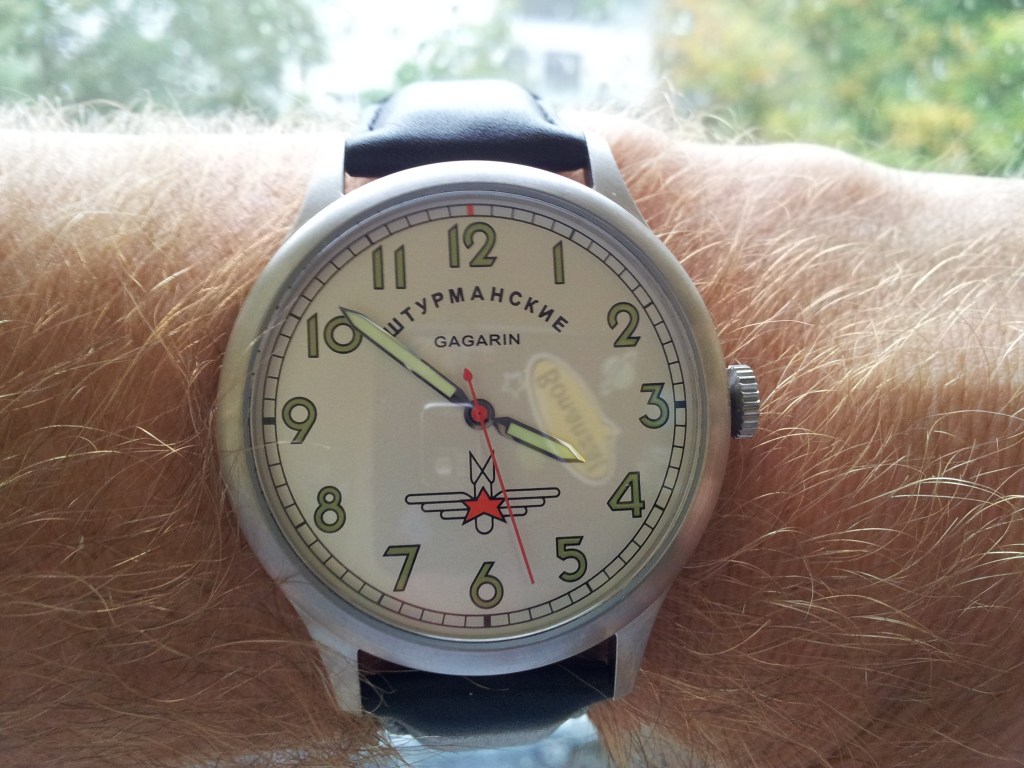
The watch face was especially striking. I adored its retro appearance; its simplicity I found beautiful — a cream-coloured face, luminous hour and minute hands, the name Штурманские and Gagarin typeset into the face, and the crowning glory to me, an iconic winged red star logo. On the rear of the watch was an inscription of Yuri and the date of his historic space flight. I looked at it for some considerable time. The price was reasonable, but surely Yuri Gagarin would have worn something else. I returned the catalogue, selected some music to listen to via my iPhone and headphones, settled back, closed my eyes and dozed until we were notified of the approach to Liverpool.
Act III: Watches In Space
During the weekend I found myself thinking about how I had read Yuri Gagarin had worn a mechanical wristwatch during that historic flight. I felt sure he would have worn something far more advanced than the catalogue blurb claimed. Doing some minor digging about Yuri Gagarin and the wristwatch he wore into space, I was amazed to discover he really did wear an 1MChZ (First Moscow Watch Factory) “Type 1” Sturmanskie wristwatch, simply fastened over the sleeve of his bright orange spacesuit. Taking a deeper dive into wristwatches in space, I read that whilst Yuri was the first man into space, his Sturmanskie wristwatch — or any other backup watch he had with him — was not the first mechanical wristwatch to have travelled to outer space.
The first mechanical wristwatch into outer space wasn’t even a Sturmanskie. I discovered that the story about the first wristwatch going into orbit was totally unplanned and actually occurred a month before Yuri’s flight. I was amused to read that first wristwatch in space moment had occurred during a successful test launch, flight, re-entry and landing — essentially a kind of dress rehearsal for Yuri’s mission. The rocket was actually crewed; seated within the capsule sat a life-sized human mannequin named Ivan Ivanovich. I read with astonishment that Ivan wasn’t alone. He had a fellow cosmonaut as company, a small black dog called, yes, you guessed it already: Blackie. (Чернушка or Chernushka) I was intrigued to discover more and couldn’t resist trying to verify the story. Deeper down the rabbit hole I dived.
It fascinated me to read a couple of conflicting claims. One of the flight doctors, Abraham Genin, curious about how zero gravity and severe G-forces might affect a mechanical movement, decided to conduct a clandestine experiment of his own. He picked his trusty Pobeda (Победа) wristwatch — a watch he’d grown slightly bored of, but admired because it had survived years of rough daily wear and even swimming. Incredibly, despite the potential risk to the mission — no matter how minor — he secretly strapped it to one of Blackie’s front legs as she was being secured into her life-support crate. I also read another version that the comrade doctor wrapped the wristwatch in a cloth and placed it within the mannequin. The more I read, the more I leaned toward the version where he fastened the watch to one of Blackie’s front paws.
Launch and flight went as planned. I learned that Ivan the mannequin successfully exited the capsule on re-entry by means of an ejection seat and parachute, landing without damage. When the recovery team finally unbolted the dog’s life support crate from the capsule, after it had safely drifted down to Earth by parachute and landed in a snowy field, out popped Blackie — allegedly drenched in sweat, wildly relieved, and tail wagging — wearing a personal, inscribed timepiece on one of her legs.
I couldn’t help but laugh imagining the fallout. The moment the recovery team discovered an unauthorised watch on a space dog and turned it over to read the inscription — the doctor’s own name, Abraham Genin — his telephone must have rung. Answering, Dr Genin heard, “Comrade Doctor… we have a few questions for you.” He must have thought he was heading straight for a cold post in Siberia. Yet the watch worked, Blackie survived, and history was quietly made.
I was amazed to discover that Ivan the mannequin had been testing the very same landing method Yuri would use a month later: ejecting at high altitude and returning to Earth by parachute. Like most people, I had always assumed a cosmonaut remained secured inside the capsule all the way down.
I was astounded to read that prior to the ejection phase, Yuri was subjected to extraordinary physical conditions. The capsule was unexpectedly caught in some kind of spin due to external equipment that was preventing a planned, smooth re-entry. He was subjected to punishing conditions during those moments — a testament to his mental and physical conditioning. Eventually, the capsule’s spin was stopped as the intense heat of re-entry burnt off the external equipment. I like to think his wristwatch continued to work through it all, too.
As the re-entry stage kicked in, the capsule door blew off, automatically triggering his ejection at 20,000 feet. The seat separated, his parachute opened, and then a life-threatening crisis began. He had no internal oxygen supply, relying instead on a suit valve designed to open and let in outside air as he fell. The valve jammed. Having survived orbit and re-entry, Yuri was suddenly at risk of suffocating just miles from the ground. Remaining calm, he used a small mirror on his sleeve to locate the stuck valve and work it open, finally letting the air rush in.
Act IV: Up Front Sturmanskie Owner
On my return flight to Kraków, there was no hesitation. Being an easyJet Plus cardholder, my default choice was always an “Up Front” aisle seat in the first few rows, travelling light with just a small carry-on bag tucked beneath the seat in front of me. As soon as I sat down, before the engines even spun up, I pulled the duty-free magazine straight from the seat pocket to check that the watch was still listed.
I ordered my usual coffee and ice-cold Twix, waiting with suppressed excitement as the cabin crew pushed the duty-free trolley up the aisle. Being in row two or three meant I was among the very first passengers approached. As the cart stopped beside me, I waved the attendant down, handed over my card, and bought the Sturmanskie right there in my seat. I sat back with the box in my hands, quietly thrilled.
On my wrist circa 2012 — a quiet source of pleasure.
I wore my Sturmanskie wristwatch with pride; it gave me a great deal of enjoyment. Whilst not a mechanical watch, clearly manufactured for travel retail, I adored everything about it. It looked different, it kept perfect time, it was light and discreet, and it didn’t draw any attention — not that I noticed anyway. I don’t remember a single comment ever being made about it… until a cold December night in 2017.
Act V: The Collision
Years later, after I had returned to the UK, I took a seasonal Christmas job with a well-known wine company in my hometown. The wine itself didn’t quite suit my palate, but the delivery side of the business suited my soul. It was tough, physical work — navigating rough roads, biting winter weather, and long hours across a massive rural territory — but it gave me purpose.
It was on one of those gruelling, freezing winter nights that my path crossed with a different kind of reality. Exhausted, having missed my breaks, I pulled into a brightly lit service station, drawn in by the promise of a hot coffee. Needing a little extra comfort, I skipped the stale pastries and walked into the main shop to find a chocolate bar — subconsciously, perhaps, chasing the comfort of that ice-cold Twix from my easyJet days.
As I walked through the door, I froze. Standing inside were two people, one of whom was a prominent television celebrity — a highly experienced antique expert and auctioneer whose sharp wit and deep historical knowledge I had admired on screen for years.
Yielding to a rare moment of spontaneous curiosity, as I passed her I extended my arm to show her the cream dial and the red winged star. I asked a light-hearted, polite, and completely respectful question: “Any value?”
I knew it wasn’t a rare 1957 vintage mechanical timepiece. It was a joke, a brief moment of human connection on a cold night.
She looked at the watch, then looked at me, and delivered a line that hit me like a physical blow: “Worthless, utterly worthless… just like you.” She then looked away.
The words blindsided me. Having spent nine years in the Royal Navy as an aircraft firefighter and medic, followed by a long police career spent handling some of the roughest parts of society, I had seen life at its rawest — and had been called almost everything under the sun — and had learned to brush it off. But, I had never been called worthless. Never. Nor had I ever used such a word to describe another human being.
Speechless, confused, and carrying a deep, heavy hurt, I didn’t stop; I just continued to walk out into the cold night, instantly blaming myself for opening the door to such cruelty. I blamed myself. I really did. What on earth did I expect? I was horrified, even ashamed. I sat in the driving seat of my van, wishing I were somewhere else. It was dark, bitterly cold, and beginning to drizzle. I had two more deliveries and was a long way from home. I sat there for some time, having lost my appetite and any desire to drink my rapidly cooling coffee. I tried to find excuses for her behaviour: she was having a bad day, perhaps; maybe she thought me rude, stupid, or worse — not socially worth engaging with. I made a vow to myself: I must not tell anyone else. It was just so hurtful and embarrassing.
The Sturmanskie came off my wrist that night. I couldn’t look at it without tasting the bitterness of that encounter. I tucked it deep into my sock drawer, hoping to bury the memory with it. I often saw the same celebrity on television, despite holding no malice or ill will towards her, it was difficult viewing. The memory of that night just returned to haunt me. I’d walk away, turn the channel over… anything just to not re-live that night. Even years later, whilst I was preparing some food, my daughter called out, hoping to tease me, “Hey dad, you like this lady on TV, yes?” I turned around to see the same celebrity on the screen. I nearly, so very nearly, explained to my daughter what the person had said to me. That she had described her father as worthless. I just couldn’t relate the sorry tale. I felt my story might not be believed, or my daughter would understand the hurt I’d experienced and feel sad for me.
Act VI: Forgiveness and Reclaiming the Star
So, my watch lay there under a pile of socks, ticking away in the dark until the battery drained, and the hands stopped at 3:26 — morning, afternoon, the exact date, I have no idea.
Until a few days ago.
While tidying up my sock drawer, I came across the simple cream face and the iconic red star and brought the memory back to me. Holding it again, the fog of that old encounter finally cleared, and the true legacy of the watch came rushing back.
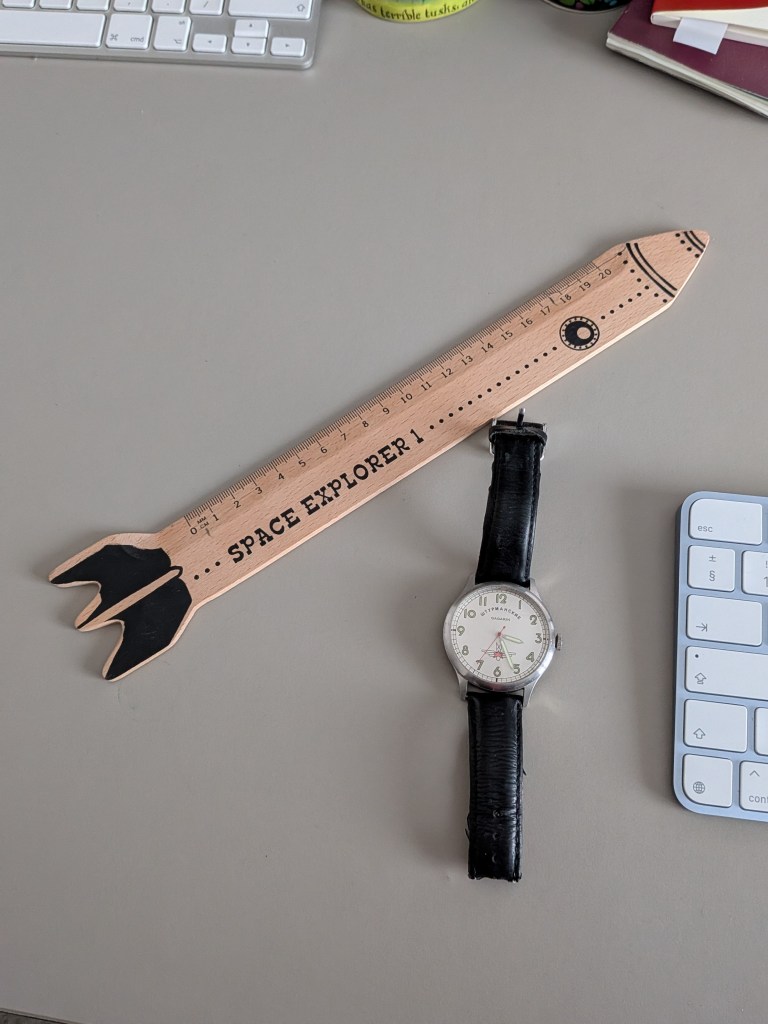
Out of the sock drawer after eight years. Needs a battery and a new strap, all system go.
A television auctioneer can only see value if an item can be bought and sold for a profit. But some things possess a wealth that cannot be measured in pounds and pence. This watch carries the spirit of a life-sized mannequin named Ivan, flung into the atmosphere to pave the way for history. It carries the memory of Blackie the dog, charting unknown territory with a secret timepiece strapped to her leg. It carries the weight of Yuri Gagarin, choking for oxygen beneath a canopy of silk, proving that humanity could reach for the stars and survive the fall.
More than that, it carries my own history. It is a monument to my leap of faith into Poland, to the happy memories of Silesia, and to the resilience it took to rebuild my life and deliver an honest day’s work on freezing rural roads.
A wristwatch tells you where you are in time. It took me years to realise that this simple watch was waiting for me to catch up to it. It doesn’t belong at the bottom of my sock drawer, and its worth is not dictated by a cruel word in a service station. It belongs on my wrist. It just needs a new battery, and then, like the cosmonauts before it, it will be ready to face the world once more.
Britam itself didn’t end with a final lesson I can clearly recall. There was no single closing moment. It blurred, as meaningful things often do, into a series of days that gradually became something else.
What remains is not a last class, but a feeling.
Of movement and pause. Of leaving, but carrying something forward without fully understanding it at the time.
Because it was never just teaching.
It was trust, given in different forms. In classrooms above shops, in offices, and in courtrooms where laughter briefly replaced protocol. It was the privilege of being allowed into people’s lives — not as an authority, but as someone they could meet halfway in language.
And somewhere in those final months, without ceremony, it became enough.
Enough to carry.
Enough to return to, years later, and still feel its weight — not heavy, but grounding.
Gliwice had a way of doing that. Of taking something improbable — like a British ex-cop teaching English to judges under the watch of a Soviet-built tank — and making it feel, for a time, entirely natural.
As if it had always been waiting.
My time at Britam didn’t really end.
It just… continued elsewhere.
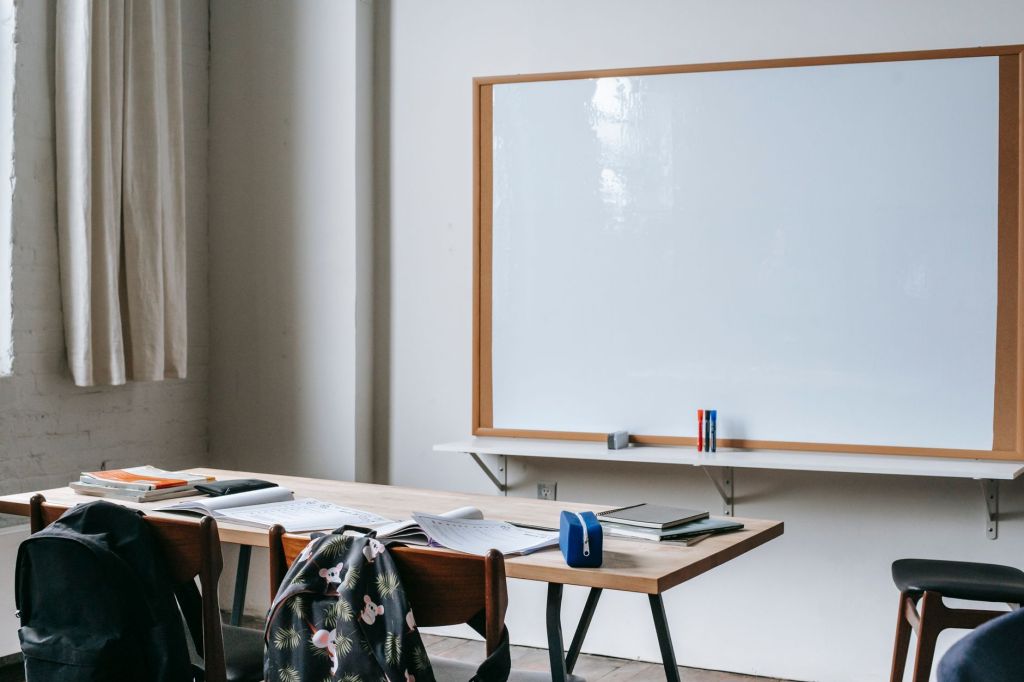
The smallest classroom, top floor, Górnych Wałów, 2014
Even after I left, they kept the door open for me. Not for a few weeks, not out of politeness, but for two or even three years. Christmas messages. Easter greetings. Small notes that simply said they hoped I was well, that they were thinking of me, that I was missed.
It wasn’t obligation. It wasn’t formality.
It was affection — the kind that lingers long after the work is done.
They meant it when they said, “There will always be a place for you here.”
And they proved it, quietly, consistently, without expectation.
For all the lessons I taught in those years, there were just as many I was learning without realising it.
I learned how to improvise, how to navigate a city that didn’t always make sense, how to keep a class afloat when the plan fell apart, how to solve problems on the fly. I wasn’t helpless. I wasn’t drifting. I did the work.
But I can also see now — with the distance of time — that I didn’t do it alone.
There were colleagues who stepped in before things tipped. Students who offered small kindnesses without knowing their timing. People who watched out for me in ways I only understand properly now.
It could have gone wrong more than once. It didn’t. And that wasn’t an accident.
In May of 2014, teaching English in Poland eventually came to a close. But the truth is, those years didn’t simply close behind me. They settled into place, shaped by the people who made sure I got through them and by the work that asked more of me than I knew I had.
This chapter ends here.
But the story it started kept going.
It kept going not in dramatic turns or another move on a map, but in the quiet, living curiosity it left behind. In a lasting fascination with Polish history, art, and culture that still finds its way onto my bookshelf today. In the patience I bring to writing, and in the way I pay attention to the world around me.
Gliwice gave me a different set of eyes. The work finished, but the perspective stayed.
🇵🇱
To, co pozostaje
Britam nie zakończył się jedną, wyraźną lekcją, którą mógłbym dziś bez trudu przywołać w pamięci.
Nie było jednego, ostatniego momentu. Wszystko rozmyło się tak, jak rozmywają się rzeczy naprawdę ważne, przechodząc powoli w coś innego poprzez serię zwyczajnych dni.
To, co pozostało, nie jest wspomnieniem ostatnich zajęć, lecz pewnym uczuciem.
Uczuciem ruchu i zatrzymania. Odejścia, które jednocześnie było zabraniem czegoś ze sobą, choć wtedy jeszcze nie do końca rozumiałem czego.
Bo przecież nigdy nie chodziło wyłącznie o nauczanie.
Było w tym zaufanie przybierające różne formy. W salach lekcyjnych nad sklepami, w biurach i na sądowych korytarzach, gdzie na chwilę śmiech potrafił zastąpić urzędowy ceremoniał. Był też przywilej wkraczania do ludzkich historii, nie jako autorytet, lecz jako ktoś, kto spotykał drugiego człowieka w połowie drogi języka.
I gdzieś podczas tych ostatnich miesięcy, bez fanfar i pożegnań, stało się to wystarczające.
Wystarczające, by nieść dalej.
Wystarczające, by wracać do tego po latach i wciąż odczuwać jego ciężar. Nie ciężar przygniatający, lecz taki, który daje oparcie i przypomina, skąd się przyszło.
Gliwice potrafiły robić coś takiego.
Brały rzeczy pozornie nieprawdopodobne, jak brytyjskiego byłego policjanta uczącego angielskiego sędziów pod czujnym spojrzeniem czołgu z czasów Związku Radzieckiego, i sprawiały, że przez jakiś czas wydawały się całkowicie naturalne.
Jakby wszystko od początku właśnie na to czekało.
Tak naprawdę moja historia z Britamem nigdy się nie skończyła.
Po prostu… trwała dalej gdzie indziej.
Najmniejsza sala lekcyjna. Ostatnie piętro, ul. Górnych Wałów, 2014 r.
Nawet kiedy wyjechałem, drzwi pozostały dla mnie otwarte. Nie na kilka tygodni i nie z grzeczności. Przez dwa, może nawet trzy lata.
Życzenia bożonarodzeniowe. Wielkanocne pozdrowienia. Krótkie wiadomości z nadzieją, że wszystko u mnie dobrze. Że o mnie pamiętają. Że mnie brakuje.
Nie był to obowiązek.
Nie była to formalność.
To była życzliwość i sympatia, które pozostają długo po zakończeniu wspólnej pracy.
Kiedy mówili:
„Tu zawsze będzie dla ciebie miejsce.”
naprawdę mieli to na myśli.
I udowadniali to po cichu, konsekwentnie, niczego w zamian nie oczekując.
Przez wszystkie lata, gdy prowadziłem lekcje, równie wiele rzeczy sam przyswajałem, nawet nie zdając sobie z tego sprawy.
Nauczyłem się improwizować. Nauczyłem się odnajdywać w mieście, które nie zawsze dawało się zrozumieć. Utrzymywać zajęcia na właściwym kursie, gdy plan rozsypywał się w ostatniej chwili. Rozwiązywać problemy na bieżąco.
Nie byłem bezradny.
Nie dryfowałem bez celu.
Wykonywałem swoją pracę.
Dziś jednak, z perspektywy czasu, widzę także coś innego.
Nie robiłem tego sam.
Byli współpracownicy, którzy pojawiali się, zanim sytuacja zdążyła wymknąć się spod kontroli.
Byli uczniowie, którzy okazywali drobne gesty dobroci, nie wiedząc nawet, jak wiele znaczyły w danym momencie.
Byli ludzie troszczący się o mnie na sposoby, które dopiero teraz naprawdę rozumiem.
Więcej niż raz wszystko mogło potoczyć się źle.
Nie potoczyło się.
I nie był to przypadek.
W maju 2014 roku moja przygoda z nauczaniem języka angielskiego w Polsce dobiegła końca. Prawda jest jednak taka, że tamte lata nie zamknęły się za mną jak drzwi.
Znalazły swoje miejsce.
Ukształtowane przez ludzi, którzy pomogli mi przez nie przejść, oraz przez pracę, która wymagała ode mnie więcej, niż wówczas sądziłem, że posiadam.
Ten rozdział kończy się tutaj.
Ale historia, którą rozpoczął, trwa dalej.
Nie poprzez nagłe zwroty akcji ani kolejną przeprowadzkę zaznaczoną na mapie, lecz poprzez cichą, żywą ciekawość, którą po sobie pozostawił.
W trwałej fascynacji polską historią, sztuką i kulturą, która do dziś znajduje miejsce na moich półkach z książkami.
In those final months, after I’d told Britam I would be leaving, I found myself teaching with a strange mixture of sadness, freedom, and creativity. Maybe it was because the pressure had lifted, or because I wanted to leave my students with something memorable. Either way, that’s how I ended up introducing one of the most unexpectedly successful — and unintentionally chaotic — activities I ever taught: an origami exercise.
It sounds ridiculous, but it worked.
Watching, listening, describing, sequencing — all wrapped inside a simple sheet of paper.
I had learned how to make what I can only describe as an origami cube. Flat at first, then — with one gentle puff of air — it opened up into a near‑perfect little cube. Or at least something that aspired to be a cube. Some were cuboid, some were noticeably not, and a few were so structurally disappointing they really should have come with a warning label.
Through trial and error, I learned it required the stiffer type of origami paper to achieve the very best results. I lost count of how many cubes I made during reflective practice runs. At some point I realised I’d essentially become a small‑scale cube manufacturer. They began to fill a large glass bowl, looking strangely decorative — like the world’s least practical fruit.
This had to be a win‑win.
The first time I demonstrated it to a class of twelve to fourteen‑year‑olds, the reaction was instant. The flat shape lifted, blossomed, and suddenly became a cube — and the room erupted. A chorus of oohs and ahs, a few gasps, and one beautifully emphatic “No… suuuper!” — that wonderfully stretched‑out Polish way of expressing delight.
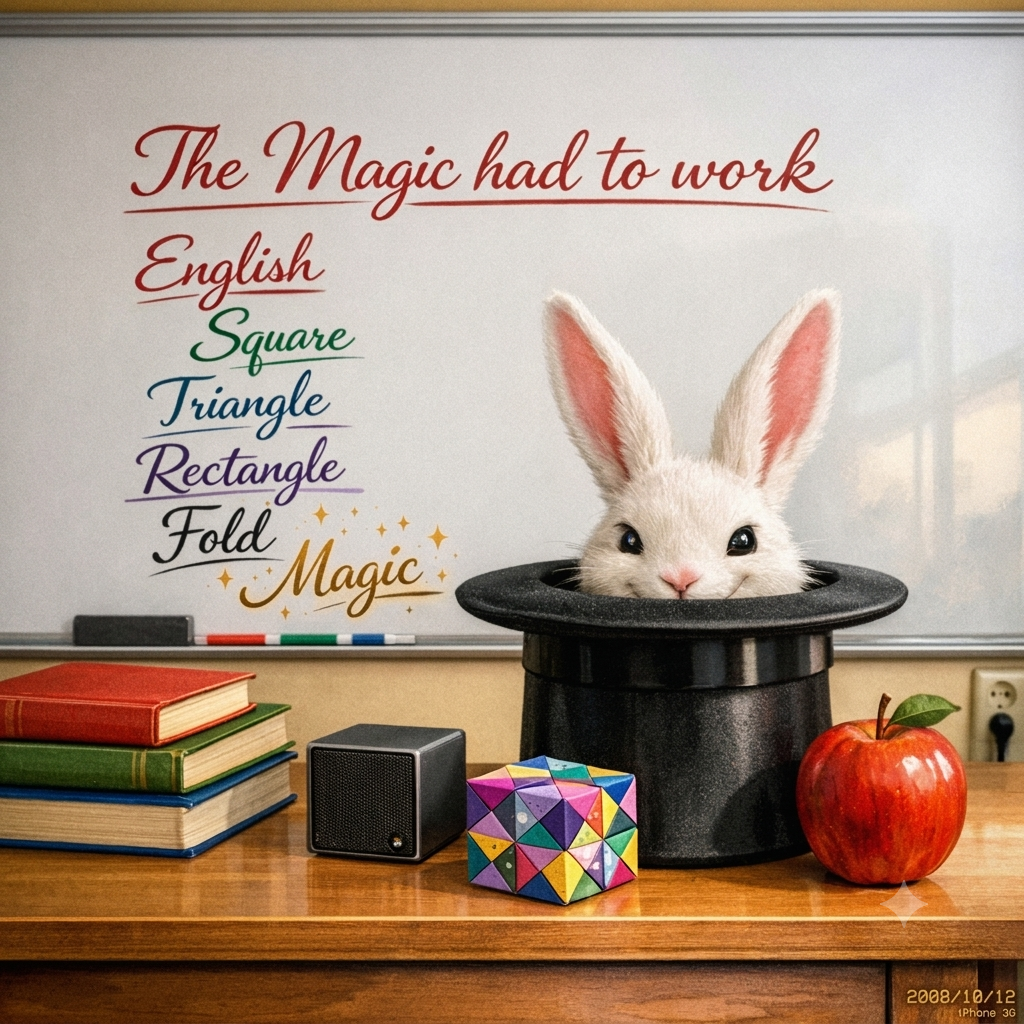
For a moment I felt like a magician.
I would make one first, slowly, narrating each fold. Then I’d hand out paper — sometimes those featuring beautiful traditional origami designs — and guide the class through their own creations. It took no more than twenty minutes, but it was one of the most joyful warm‑ups I ever used. Students carried their finished origami creations out of the classroom like a delicate piece of treasure. I even saw a few being shown off in the corridor with quiet pride.
I don’t remember a single student giving up; some made the odd mistake, which was easily rectified. In those last months, I even carried a couple of pre‑folded pieces in my pocket, just in case a student’s cube refused to cooperate. A quiet swap, no fuss — the magic had to work for everyone.
I’d learned to make what I believed was just a nice decorative object — a cube. That was the beginning and end of it. The fact that it could be used in another way had not entered my thoughts.
I used to enjoy a small moment of mischief. I’d hold up the folded shape — still flat, still mysterious — and ask them what they thought it was. The guesses were wonderfully wild: a hat, a box, a strange envelope — most students stared at it with polite confusion. But once — only once — a lad squinted at the unfinished shape and said, with the confidence of someone discovering fire, “Mr Gary… that’s a water bomb.”
I laughed it off at the time. I genuinely thought he was joking.
“Is it?” I replied. “Well… I don’t think you should try using it like that. Not here, anyway.”
In British terms, I’d describe him and his small cohort of friends as simply the lads — and, without realising it, I’d once worn a blue badge proudly declaring myself one of them. A gizd among gizdy.
The lesson came to an end; the class rushed out, happy to finish and get home. I felt good about how much fun the lesson had been; I was collecting my books and props when I heard a commotion on the landing outside — real chaos: screams, shouts, and the unmistakable sound of a teacher trying to restore order. I popped my head out, fearing the worst.
To my horror — but not, if I’m honest, my surprise — I discovered that four of the lads, including the one who’d proudly identified the “water bomb,” had gone straight into the students’ toilet and filled each of their paper creations to maximum capacity with tap water. They had then burst out onto the landing like a budget version of Royal Marine commandos: choosing targets with military precision — and throwing them with absolutely none.
It was, in its own way, impressive.
Less impressive was the aftermath.
One or two bombs had missed their intended victims entirely, exploding against the walls. Water splashed down the steps, forming a small but ambitious flood on the stairs and landing. I could see two other students wiping water from their clothing and rucksacks, somewhere between outrage and laughter.
And there they were — the lads.
Standing halfway down the stairs, one holding the sad remains of what had once been a perfectly innocent origami cube.
They looked up at me with identical expressions: wide‑eyed, hopeful, and silently pleading.
As if to say: Mr Gary… you made us do it.
More teacher colleagues arrived — this was now rather more serious than I really wanted it to be.
The lads were promptly instructed to wait outside the School Director’s office — a place no student ever wants to be sent. A detail I had somehow managed to forget in the heat of the moment.
Was I to join them too?
Our school cleaner arrived soon after — a kind, funny, deeply patient woman with whom I somehow managed to have regular conversations despite her having no English and my Polish hovering somewhere around survival level. I think her name was Pani Ewa. Time has blurred the certainty, but not the person. What I remember clearly is her warmth and kindness.
Pani Ewa took one look at the flooded stairs, then at me, and pulled an expression of theatrical despair that clearly meant: Excellent. More work. Then she laughed when she saw how worried I was.
All I could really do was shrug my shoulders, say sorry, and offer to mop up the water. She laughed and shook her head. The colleague who had first arrived to restore order burst out laughing too. No matter how much I offered, I wasn’t allowed near any mop or bucket.
A full health and safety alert was declared — rightly so — though not the sort usually triggered by sightings of unlabelled yoghurt or someone reheating a fish dish in the staff microwave.
My close friend had also just finished with her own class, and, hearing the commotion, arrived to see what the fuss was. She shook her head and gave a sympathetic look at Pani Ewa.
“Gary… what exactly were you doing with that group?”
A fair question, delivered with a raised eyebrow and a damp mop nearby.
I apologised, of course. It wasn’t supposed to have ended like that; I didn’t know the cubes could be converted into paper-and-water ammunition, or that they’d actually be used on school premises — after all, I had advised it wasn’t a good idea.
But secretly, I couldn’t help thinking:
They had listened. They had followed instructions. They had created something. And then, being teenagers, they had weaponised it.
It was absurd. It was harmless. It was very, very Britam.
As I made my way to the teachers’ room — my work done — I passed the lads, now slightly subdued, still lined up outside the Director’s office where a small crowd of their peers teased them without mercy. It was almost enough to make me feel sorry for them.
Almost.
I half‑expected I would have to face our Director too, perhaps to receive some advice — perhaps to think carefully about what the more spirited younger students might do with such a versatile little object. But no advice or gentle warning ever came. The activity stayed on the timetable, unbanned and unblamed, and the students kept folding cubes with the same enthusiasm — just with slightly less interest in their aerodynamic potential.
Classes finished at 8:20 p.m., and if my friend had been teaching at the same time — which happened often — she’d already have offered me a lift home. We’d meet during the ten‑minute break between lessons, and by the time I finally made it down to the teachers’ room with my usual mountain of books and props, she’d be there chatting to Pani Ewa.
She would always ask about my day, whether I was enjoying life in Poland, whether I was settling in. She never showed a flicker of impatience — if she felt any, she was too gracious to let it show. It was always my friend who eventually said, gently, “We should let Pani Ewa lock up…”
Nothing was rushed. I’d apologise, we’d all smile, and then she’d close the big glass doors behind us and disappear back into the building.
Stepping out into the night air — no matter the weather — always felt strangely refreshing. A small, quiet ending to the day, held together by two women who looked after me more than they probably realised.
And it happened during the same months when everything else in my life felt heavy. Somehow, that small disaster — that ridiculous, soggy moment — reminded me that even as I was preparing to leave, the place hadn’t dimmed. Not really.
2026: Still able to create origami cubes for decoration and enjoyment. Or a single‑use‑only water bomb for chaos and mischief. Gizd‑friendly budget Biedronka model shown in red. Water or other liquid not supplied. Supervision strongly recommended.
Something
There’s another memory from those months that still makes me laugh. I once took a photo of one of my livelier groups — twelve‑ to fourteen‑year‑olds in full, unfiltered mode: peace signs, wild grins, the kind of joyful chaos that made every lesson feel like a small festival. I can’t use the photo, of course. Children deserve their privacy, especially now. But in the background, on the whiteboard, you can just make out a single word written in huge letters: SOMETHING.
I remember exactly how it happened. Faced with a room vibrating with energy and absolutely no plan left in my head, I tapped the board and announced, with the confidence of a man bluffing for his life, “Right. How many English words can you make from SOMETHING?”
And somehow, unbelievably, it worked. They fell on it like detectives, shouting out answers, arguing over spellings, turning a single word into a competition that lasted the whole cool‑down. It was pure improvisation — panic disguised as pedagogy — and yet it became one of those small, shining classroom rituals I still think about with ridiculous fondness.
They were, of course, the winning class. They always were. I may have ever so slightly embellished the rival groups’ results from time to time — just enough to keep the momentum alive. The only embellishing I’ve ever done in my writing or my teaching, and entirely in the name of teenage motivation.
They would cheer, punch the air, and look at me with the fierce pride of a team that had conquered Everest using only a whiteboard marker and the word SOMETHING. And I’d stand there, trying not to smile too obviously, thinking: if only they knew how close the other class actually came.
There was still laughter in the rooms I taught in. Still that strange, bright energy only teenagers can generate.
And for a little while longer, I was still standing in the middle of it — damp stairs, water bombs, origami magic and the endless possibilities of SOMETHING.
A companion piece to ‘Kalimankou Denkou’ (Калиманко Денко)
Unlike hearing and then owning a 4AD label vinyl copy of Le Mystère des Voix Bulgares during the 1980s, I would have heard “Tsintskaro” through Herzog’s Nosferatu and later through Kate Bush’s “The Ninth Wave”. Yet if I am honest, I cannot claim to have truly heard it at all. At nineteen, sitting in a Hamburg cinema, bewildered and vaguely horrified by Klaus Kinski’s Count Orlok, I found Georgian polyphony to be the furthest thing from my mind. Years later, when I bought Hounds of Love on a rainy trip to Salisbury, my attention was elsewhere again. The song passed me by twice without leaving a footprint.
It would take another forty years before it finally stopped me in my tracks as I walked through the Chester Rows.
It was only quite recently, when on a shopping trip to Chester and using my earbuds to listen to an episode of BBC’s Ultimate Calm via the Sounds app, that a guest on the programme began to describe how and why he had chosen Hamlet Gonashvili’s, Tsintskaro as his own “safe haven” track. Admittedly, I had no idea who Hamlet Gonashvili even was. I caught something about how he had climbed a tree to pick an apple and, whilst doing so, had fallen to the ground with fatal consequences.
I continued to walk around the Chester Rows, listening. After no more than twenty seconds, I had to stop. I stood listening as this remarkable vocal range and atmosphere transported me outside the commercial centre of a city and far beyond. I pulled out a notebook and wrote down a reminder to discover more about the track.
If the voice of Yanka Rupkina is a confession trapped within the human chest, the voice of Hamlet Gonashvili is that same confession dissolving into the ancient earth. It belongs to the same architecture of silence, but here the unyielding law casts a different shadow.
While “Kalimankou Denkou” mourns a love forbidden because the two people are bound too closely by sacred village kinship, “Tsintskaro” seems to mourn something different: the sudden, impossible distance between two strangers.
And perhaps that is what lies behind the encounter in “Tsintskaro”.
A man passes the village spring and sees a beautiful girl carrying a water jar. He speaks a single word, perhaps a greeting, perhaps something more. Whatever he says, she becomes angry and steps away, protecting herself from the attention of those around her.
What, I wondered, could have made her so angry?
The answer may lie somewhere in the social world from which the song emerged, in customs and expectations that a modern English listener can easily overlook. As I read further, I came across the notion of namusi (ნამუსი), a concept of honour and propriety that once shaped much of daily life throughout the Caucasus.
The more I read, the more I found myself imagining the village spring differently. What appears, at first glance, to be a simple meeting between two young people might have carried meanings invisible to an outsider. Perhaps a brief exchange could invite gossip. Perhaps a young woman might be expected to guard her reputation carefully in a public place.
But perhaps I was also doing what outsiders so often do: filling a silence.
One of the things I have come to love about traditional songs is their refusal to explain themselves. They offer a glimpse through a doorway, then leave the listener to wonder what lies beyond. The further I followed this particular trail, the less certain I became that I understood the girl’s anger and the more certain I became that the uncertainty itself was part of the song’s power.
It is an extraordinarily small human encounter. Yet Hamlet Gonashvili’s magnificent three-part polyphony gives it the scale of something much larger. The deep bass seems to carry the weight of the world around them, while the soaring voice above it gives expression to something fleeting and painfully human. The music transforms a moment beside a village spring into something timeless: attraction, restraint, misunderstanding, and the invisible boundaries that separate one person from another.
By the water, the door is closed, just as firmly as it was at Denka’s threshold.
Teaching across different schools and companies meant movement, and movement meant carrying half my working life on my back.
I had a little drawer in the teachers’ room at Górnych Wałów, but it held only the essentials: Jedyna chocolate, Prince Polo bars, and my backup supply of Śląskie Szloki boiled sweets. Because I was constantly on the move, I couldn’t rely on keeping my props and teaching materials in one place. So I carried everything with me, often including two different grammar books and their matching answer keys, depending on the level of each group.
My load included worksheets, a bewildering assortment of props, my iPad, MacBook Pro, Bluetooth speaker, portable Wi-Fi unit, spare marker pens, emergency lesson plans, and the inevitable Plan B, C, and D.
I didn’t just carry my materials, either. I carried them in style, though not intentionally.
Two of my bags were gifts from friends who shopped at Gryfnie in Katowice, that wonderful little shrine to Silesian culture. One tote was printed with everyday objects labelled in Silesian, including the legendary klopsznita, the workers’ two-slice sandwich that seems to have sustained half of Upper Silesia since coal was king. The other proudly announced, also in Silesian, that I was a student at the University of Katowice. I wasn’t, of course, but the bag had academic ambitions for me.
Then there was my Chrome messenger bag, the American urban-cyclist model with the enormous seatbelt buckle, the kind that made me look as though I were about to deliver classified documents by bicycle. I hadn’t meant to look like a hipster courier, but the bag made its own decisions.
Some days I felt less like a teacher and more like a travelling technician who happened to resemble a Silesian-themed exchange student with a side gig as a bike messenger, ready to improvise at a moment’s notice. Whatever the day demanded, I carried it, literally, along with the quiet hope that Plan A would behave itself.
It was a strange kind of devotion: the weight of a working life slung over both shoulders. Yet it felt right. It felt like doing the job properly.
I still laugh at the memory of it. My colleagues would watch me sweep into the teachers’ room, unzip the bags, and begin laying out materials like a magician preparing for a trick nobody had requested. Then I’d head into lessons, where students watched me unpack the three-bag system like a travelling circus arriving in town.
Whether it was the biggest classroom in Zabrze or the tiny room at the very top of Górnych Wałów, a particular favourite despite the puffing and panting required to reach it, the reaction was always the same.
I would open my bags and their eyes would widen.
Out came the books, the props, the worksheets, the iPad, the MacBook, the portable Wi-Fi unit, the cube speaker, the emergency markers, the backup plans.
By the time everything was spread across the desk, I looked less like an English teacher and more like someone preparing to run a small independent broadcasting studio.
It is funny now.
To be honest, it was funny then as well, though at the time I was usually too out of breath to admit it.
Timing the end of a lesson became an art form. Packing everything away took time, so I used the timer on my iPhone with an audible alarm. Eventually I learned how to chop MP3 files and use fragments of song intros or odd sound effects as signals to begin packing while keeping the conversation going. I became surprisingly creative with audio cues, and sometimes the students laughed so loudly it carried into the adjacent rooms and out to the next class waiting in the corridor.
Of course, carrying so much equipment came at a price, a personal one. I knew it. I weighed it up. The lessons were working, the technology was opening doors, and I could bring almost anything into almost any classroom.
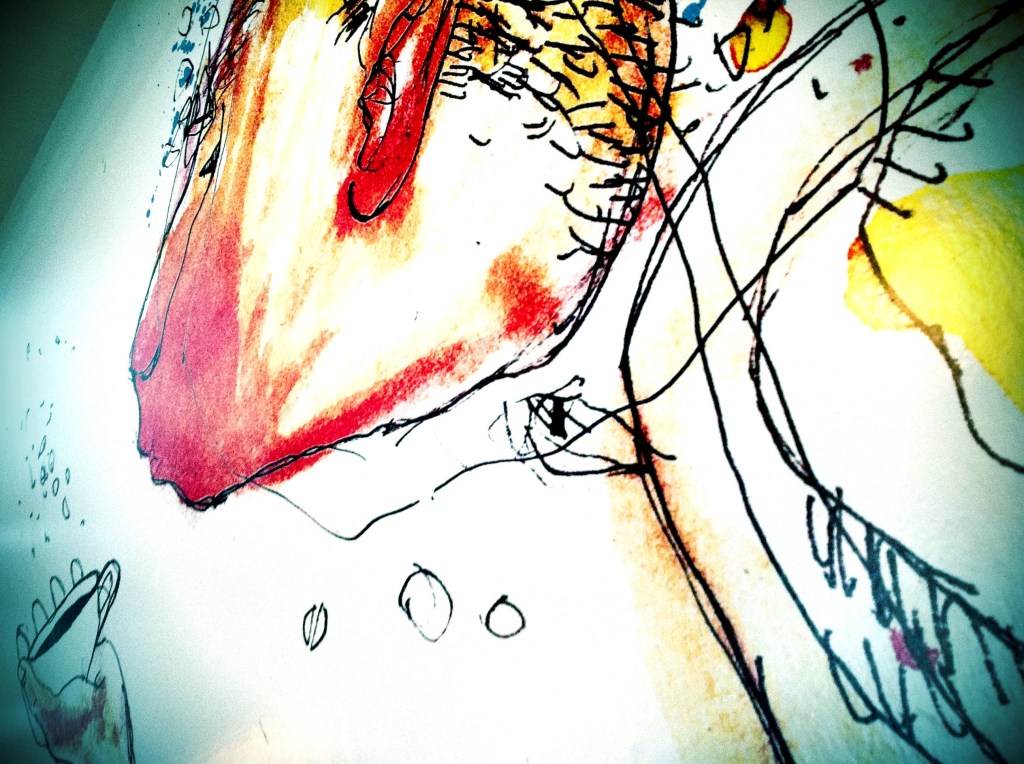
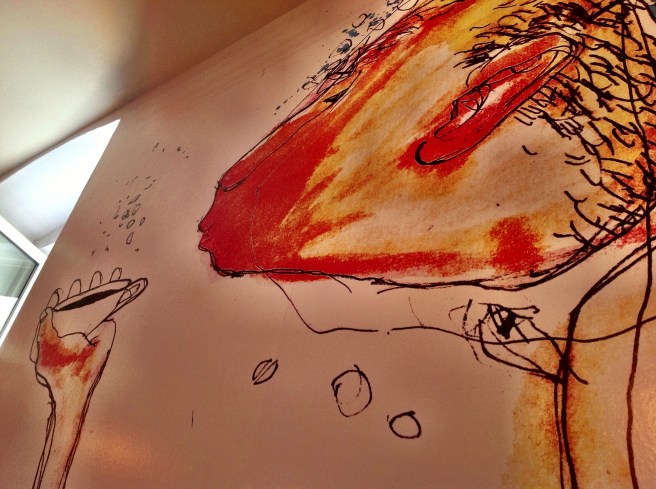
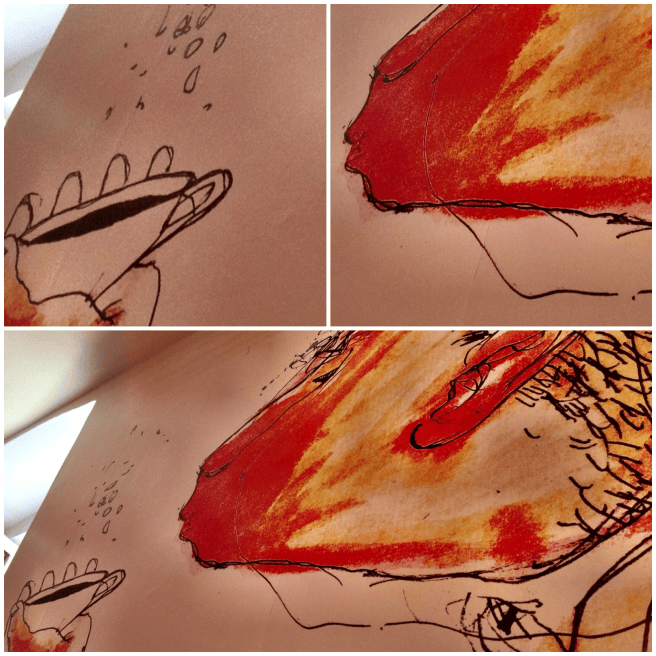
For a time, this mural dominated the back wall of KAFO Kawiarnia in Gliwice. I adored it and would often gaze at it, tracing its outline, noting the colours and trying to imagine who the character might represent.
I once had a conversation with Paweł about it, and suggested it was a portrait of himself, which he dismissed with a quiet chuckle. Incredibly, Paweł sent me a hard copy of the work. I used it as a background on my MacBook Pro for years. It was a generous thing to do and typical of Paweł, who was delighted the mural gave me so much pleasure.
I no longer have the MacBook, nor can I find my data stick with the hard copy on it. Furthermore, I clearly didn’t back up a copy on any cloud service either. A huge regret — so all I have left are images of the mural taken at strange angles on a 2010 iPad.
I recently recovered some files from the iPad before it gave up completely: two images and a collage. I have searched for any clues as to the name of the artist, and I await to hear from KAFAR (formerly KAFO) to shed any light on the artist concerned.
If you know who created this work, please let me know in the comments below. Thank you.
Poniżej znajduje się wersja w języku polskim / Polish version below.
W poszukiwaniu artystki: Mural w KAFO
Przez pewien czas ten mural dominował na tylnej ścianie KAFO. Uwielbiałem go i często wpatrywałem się w niego, wodząc wzrokiem po konturach, dostrzegając odcienie i próbując wyobrazić sobie, kogo może przedstawiać ta postać.
Rozmawiałem o nim kiedyś z Pawłem i zasugerowałem, że to jego portret, co zbył cichym śmiechem. Niesamowite, ale Paweł przysłał mi potem cyfrową kopię tej grafiki. Używałem jej jako tapety na moim MacBooku Pro przez lata. To był z jego strony niezwykle hojny gest – tak bardzo w stylu Pawła, który cieszył się, że ten mural sprawia mi tyle radości.
MacBooka już nie mam, nie potrafię też odnaleźć pendrive’a z tamtym plikiem. Co gorsza, nie zapisałem kopii w żadnej chmurze. Bardzo tego żałuję — jedyne, co mi zostało, to zdjęcia muralu zrobione pod dziwnym kątem starym iPadem z 2010 roku.
Niedawno udało mi się odzyskać kilka plików z iPada, zanim całkowicie odmówił posłuszeństwa: dwa zdjęcia i kolaż. Szukałem jakichkolwiek wskazówek co do nazwiska autorki i czekam na wiadomość od ekipy KAFAR (dawniej KAFO), która miejmy nadzieję rzuci światło na jej tożsamość.
Bardzo chciałbym oddać jej należne uznanie i podpisać ją jako autorkę, zwłaszcza że jej praca przez lata pojawiała się na moich zdjęciach i we wpisach o KAFO. Jeśli wiesz, kto stworzył ten mural, daj mi znać w komentarzu poniżej.
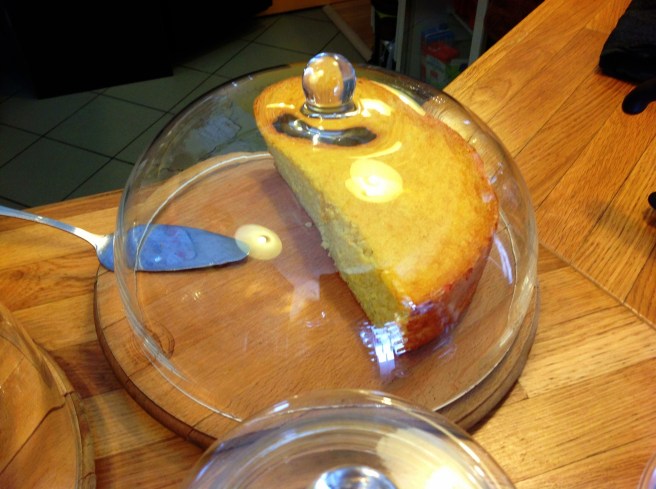
Bella GoodCake always arrived at KAFO the same way: a soft clatter of the door, a gust of outside air, and then the unmistakable sight of her carrying those enormous, see-through cake containers. They weren’t tins or boxes, but something sturdier, almost ceremonial. They looked like protective domes for precious cargo—the kind of thing you’d use if you were transporting a crown or a newborn planet. I used to think of them as cake safes because that’s precisely what they were: round, clear, lidded vaults carrying brownies, blondies, courgette cake, and whatever other miracles she’d baked that morning.
She baked at home in those early days of 2011. You could tell. There was a kind of domestic confidence in the way she handled her cakes, as if they were children she’d raised from scratch. I’d often see her car parked outside, boot open, these cake safes lined up like treasures waiting to be carried in—a tiny, travelling bakery. She’d lift each one with a gentle, practised motion, balancing them against her hip as she navigated the doorway with the confidence of someone who knows the true value of what she is holding.
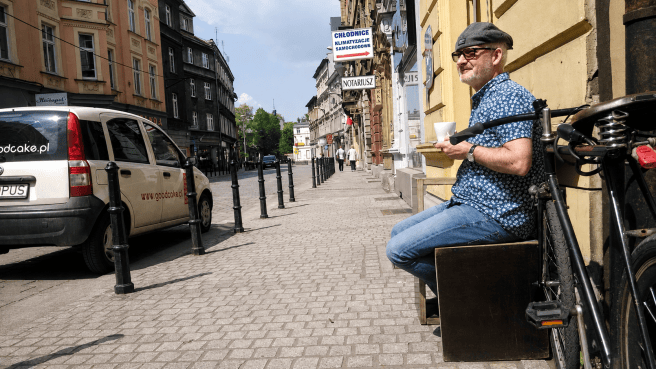
Later, she went big — her own bakery unit, proper production, the whole thing — and a white Fiat Panda with a Good Cake logo on the side. At some stage, Good Cake became a brick-and-mortar kawiarnia storefront, called Gagakiernia, very near to that Gliwice institution, Bar Teatralny, but I’d returned to the UK by then. “In my memory, she’s forever the woman arriving at KAFO to unload cake safes full of miracles from the boot of her car.”
Cake as in Good Cake
Bella always seemed to find time to stop and chat with me. Always. At the time, I only knew her from these brief interactions, and I was quietly surprised when she would choose to pull up a chair or plonk down next to me on my favourite part of the bench to spend ten or fifteen minutes talking. Maybe it was the shared language — two native English speakers in a Silesian city where English was something people studied rather than lived in. Perhaps it was the sheer novelty of speaking without searching for articles or prepositions, letting the words flow without effort. Or possibly, she just liked the company. She had that kind of warmth, the kind that didn’t need a reason.
Her accent was a soft puzzle — Scottish? Irish? Something windswept and musical. She’d married a local Polish academic she’d met at Oxford or Cambridge (I could never remember which), and somehow ended up creating cake heaven in Gliwice. She used to laugh about adjusting her recipes for Polish tastes after Paweł’s early, honest critique. “Nothing too sweet,” she’d say, rolling her eyes with affection. “If I made cakes like we do back home, they’d think I was trying to kill them.”
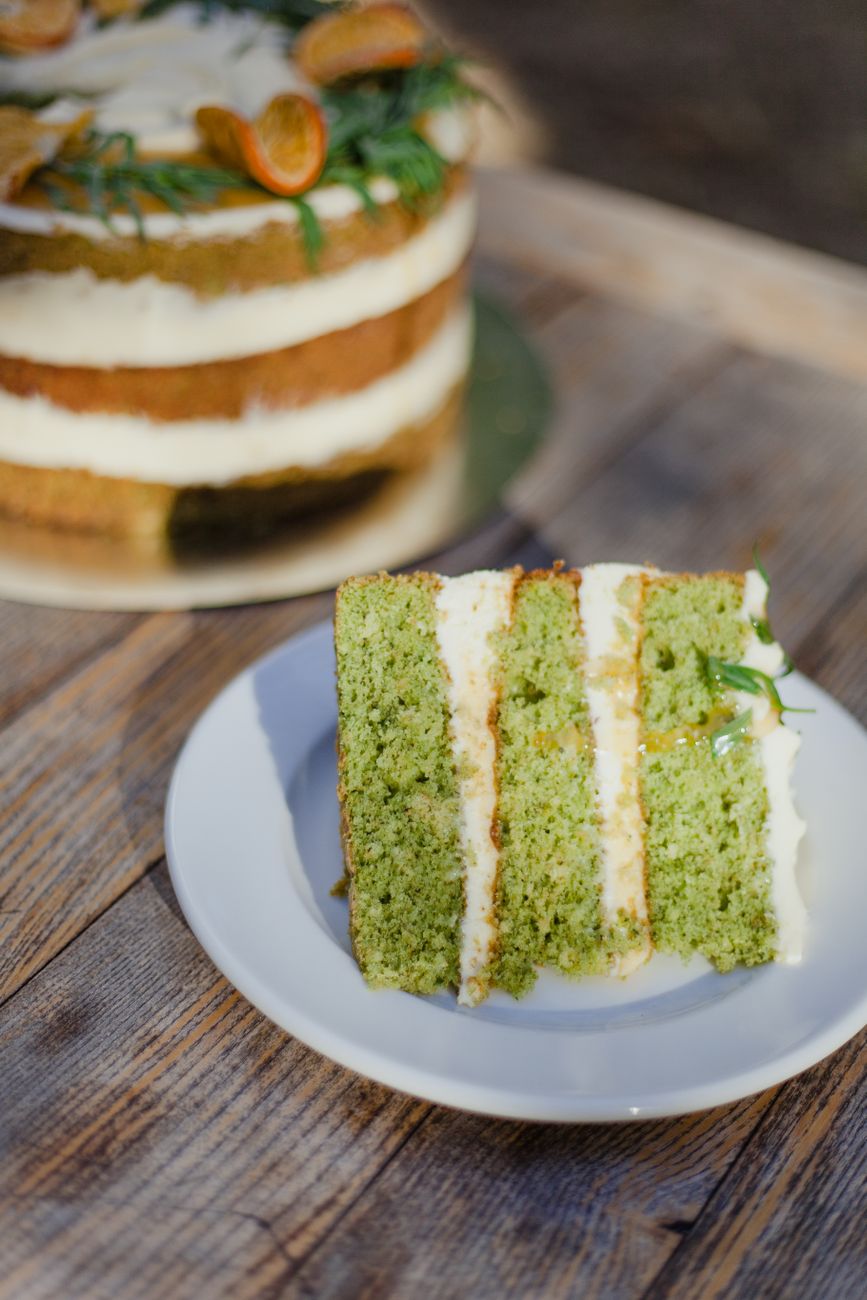
Her blondies were perfect. Her courgette cake with the thick frosted icing was the kind of thing that could make a bad week behave itself. And every time she left — cake safes empty, apron dusted with flour, hair escaping its clip—the room felt a little emptier. As if she’d taken a pocket of warmth away with her.
Epilogue: The Ordinary Magic of It All
I hadn’t thought about Bella GoodCake for years. Not properly. Not the way memory feels when it comes back warm instead of blurred. I’d almost convinced myself she was something I’d imagined — a character from a book I once read, or someone from a film I half-remembered. But writing this has brought her right into the room again.
It makes me laugh now, the innocence of it all. Me, sitting in KAFO with my lesson plans and my Gryfnie bag, trying to look like a man who knew what he was doing. At the time, I was more lost than I ever admitted. Living alone in a foreign city, teaching, drifting, trying to find my footing.
And then Bella would appear, plonking herself down for a chat as if it were the most natural thing in the world. A stranger who wasn’t really a stranger, chatting about cakes and accents, local and UK news.
I think she just liked speaking English without having to think too hard. I think I just liked not feeling quite so alone. She’ll never know what those ten minutes meant to me. How those small conversations steadied me. How her presence made the café feel less like a place I spent my time in, and more like a place I belonged.
Some people pass through your life carrying cakes. Some carry comfort. Bella carried both.
The Good Cake transporter outside KAFO. It would magically fly when no one was looking.